The Bowie-Dick test: what it proves and which autoclaves need it
The Bowie-Dick test checks one thing: whether a pre-vacuum autoclave pulls the air out of its chamber well enough for steam to reach every surface. Class B units such as the SciCan Bravo and the Tuttnauer T-Edge B run it daily. Gravity units — the Midmark M9 and M11, the Tuttnauer 2540M and EZ series — have no vacuum stage and do not use it at all.
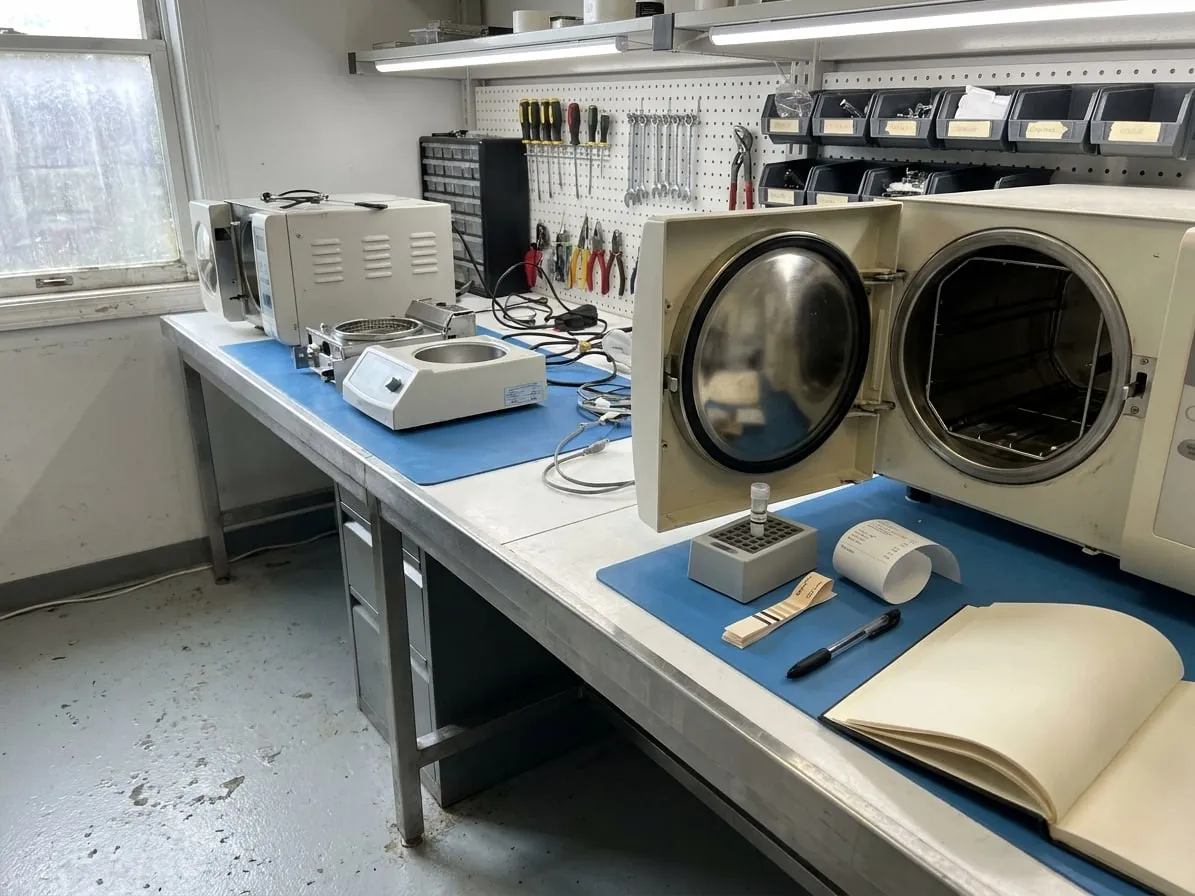
Why air removal matters
Steam sterilizes by condensing on a surface and giving up its heat. Air does not do that. A pocket of air trapped inside a wrapped pack, a lumen or a stack of pouches stays cooler than the steam around it, and whatever sits in that pocket may not be sterilized even though the chamber display reads 134 °C. Every steam autoclave has to get the air out; the difference between types is how.
- Gravity and positive-pressure units let steam push the air out through a valve or vent. The Midmark M9 and M11, for example, open an air valve about three times at roughly half the operating pressure. There is no vacuum pump.
- Pre-vacuum (Class B) units use a pump to pull the chamber down several times before the sterilizing phase — the "fractionated vacuum" the Bravo manual describes. That is what lets them handle porous loads and hollow instruments, and it is what the Bowie-Dick test checks.
What the test is
A Bowie-Dick pack (or a Bowie-Dick-type device) contains a sheet printed with an indicator ink, buried inside layers that make it hard for steam to reach. It runs alone, in an empty chamber, on the unit's dedicated B&D program — on the Bravo G4 that is a 134 °C cycle with a 3.5-minute hold and the same vacuum pulses as a normal cycle. If air removal is good, the sheet changes color evenly. If air stayed behind, it shows a paler area, usually in the middle.
Two things the test is not. It is not a sterility test — the CDC glossary calls it an air-removal test, and the spore test is still the proof of kill. And it is not a leak test, although the two are often run together: the Bravo has a separate vacuum test that measures how well the chamber holds vacuum, and a combined "vacuum test + B&D" program.
Which autoclaves need it
| Unit | Type | Bowie-Dick? |
|---|---|---|
| SciCan Bravo G4 (17 / 22 / 28 L) | Pre-vacuum, Class B | Yes — B&D program built in |
| Tuttnauer T-Edge 10B / 11B | Class B (the "B" adds vacuum) | Yes |
| Other Class B tabletop units | Pre-vacuum | Yes — follow the manual |
| Midmark M9 / M11 (all generations) | Air removal above atmospheric pressure, no vacuum pump | No |
| Tuttnauer 2340M, 2540M, E-series, EZ and EZPlus; T-Edge S | Gravity / non-vacuum | No |
| SciCan Statim 2000 / 5000 | Cassette, non-vacuum | No |
If you are not sure which type you have, two quick clues: a Class B unit has a vacuum pump and lists a vacuum test or B&D test among its programs. If neither appears on the menu, it is almost certainly not a pre-vacuum unit. Our Bravo and T-Edge pages cover those models in detail.
Why a Midmark M11 does not get one
This trips up offices that move from a hospital setting, where every big sterilizer is pre-vacuum and the morning Bowie-Dick is routine. A gravity unit has no vacuum phase for the pack to challenge, so the result tells you nothing — and a "fail" on a unit that was never designed to pass it can send a working sterilizer out for repair. Midmark's quick reference for the M9 and M11 tells users to use biological indicators made for gravity-displacement steam sterilizers. On a Midmark M11 or M9, the checks that matter are the printout or display readings on every load, chemical indicators in every pouch and the weekly spore test.
How often, and when
- Every day the unit is used, before the first load, in an empty chamber. That is the AAMI ST79 practice and Tuttnauer's recommendation for its Class B tabletop units.
- After installation, relocation or a major repair, the CDC's 2008 guideline adds three consecutive Bowie-Dick tests, alongside three empty-chamber cycles with biological and chemical indicators, before routine use.
- The Bravo manual also suggests running the vacuum test at the start of each working day with the chamber at room temperature, because a hot chamber skews the reading.
Running it on a Bravo G4
- Warm-up as the manual describes, then empty the chamber — trays and supports only.
- Place the test pack flat on the lowest tray, toward the front near the door. Nothing else goes in.
- Select the B&D program (or vacuum test + B&D) and start it.
- Read the sheet according to the pack maker's instructions and file it with the date and cycle printout.
The packs are not supplied with the unit; use an FDA-cleared Bowie-Dick pack or device and follow its own instructions, which take priority over a general guide like this one.
When it fails
Repeat it once, checking the obvious first: the right pack, an empty chamber, the correct program and placement. If it fails again, do not run patient loads until the unit is checked. On the bench, repeat failures on Class B units come back to a short list: a door gasket that lets air seep in, a weak or failing vacuum pump, a leak somewhere in the hydraulic circuit, or a blocked chamber filter. A failed vacuum test points the same way. Each of those is a part, not an adjustment, and after the repair the unit needs its three Bowie-Dick tests and three spore-tested empty cycles before it goes back into service.
Questions
Is the Bowie-Dick test a sterility test?
No. It is an air-removal test. It shows whether the vacuum stage pulled the air out of the chamber so steam can reach every surface. Sterility is proven by the biological indicator — the spore test — which you still run on its own schedule.
Does a Midmark M11 or M9 need a Bowie-Dick test?
No. The M9 and M11 have no vacuum pump; they push air out with steam above atmospheric pressure. A Bowie-Dick pack is designed for pre-vacuum cycles and gives no meaningful result in them. Midmark tells users to use indicators made for gravity-displacement sterilizers.
How often do Class B units need it?
Daily, before the first load, in an empty chamber — that is the practice in AAMI ST79 and what Tuttnauer recommends for its Class B tabletop units. After installation or a major repair the CDC recommends three consecutive Bowie-Dick tests before routine use.
What does a failed Bowie-Dick sheet look like?
Instead of an even color change across the sheet, there is a lighter patch, usually in the middle, where air stayed trapped and steam did not reach. Check that you used the right pack, placed it as the manual says and ran it in an empty chamber, then repeat. A repeat failure means the unit should not be used until it is checked.
Still not working?
Then the fault is inside the unit. We pick it up anywhere in Southern California, find the fault on the bench and quote it before any work — $125 for pickup, diagnostic and return, credited toward the repair. A loaner can ride along on the same stop.
Sources
- SciCan Bravo G4 operator manual — B&D test and vacuum test cycles
- Tuttnauer — process challenge devices: Bowie-Dick and Helix tests
- AAMI ST79 guideline summary (Solventum)
- CDC — Guideline for Disinfection and Sterilization (2008): sterilizing practices
- Midmark quick reference 004-0390-00 (M9/M11 air removal and indicators)
- FDA 510(k) K163337 summary — Midmark M9/M11