SciCan Statim autoclave repair: Statim 2000, 5000 and G4
Statim autoclave repair for the cassette sterilizers dental offices run all day: the Statim 2000 and Statim 5000, Classic, S and G4. We pick the unit up, find the fault on the bench, quote it before any work and prove the repair on full cycles before it comes back — with a Statim loaner on the same stop if you need one.
Models we see: SciCan Statim 2000, 2000S and 2000 G4; Statim 5000, 5000S and 5000 G4; older Statim 2000 units that show Check Cassette messages.
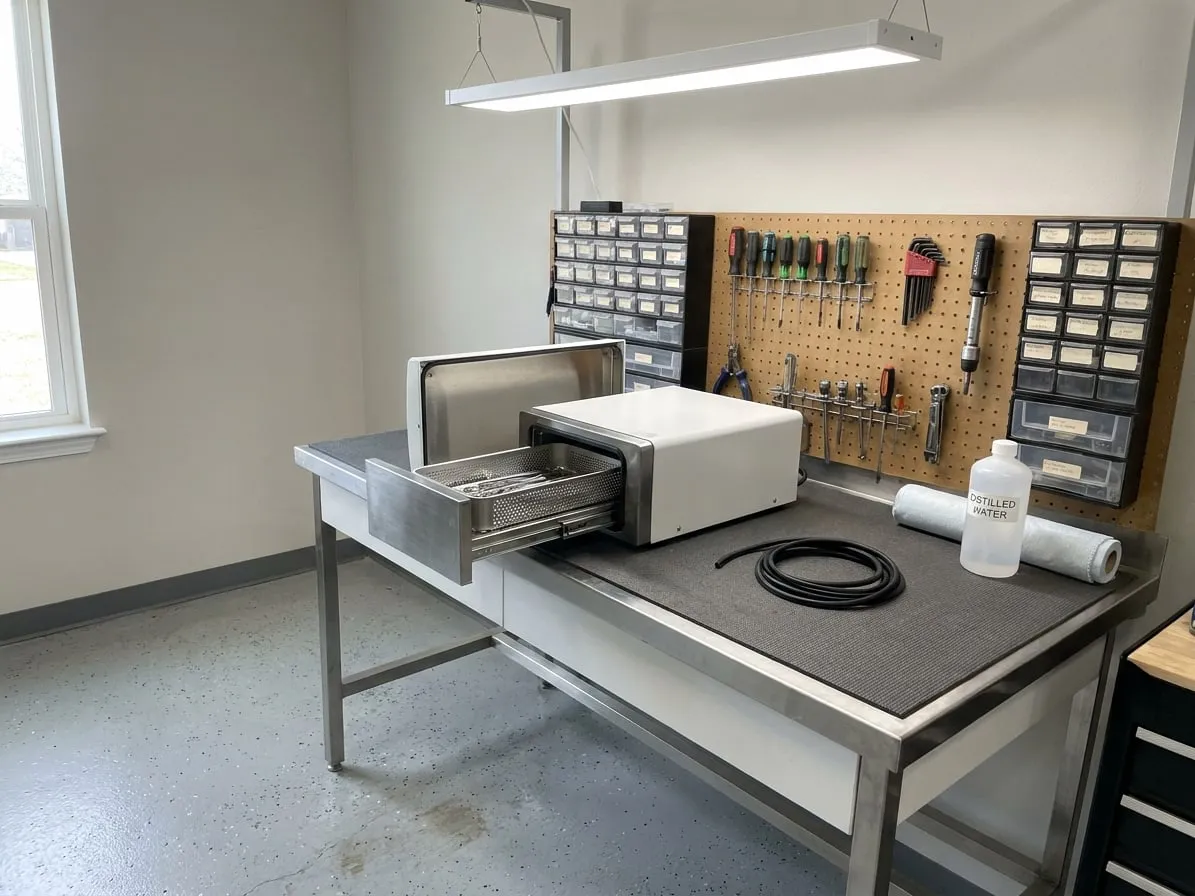
How a Statim works — and why that matters for repair
A Statim has no chamber in the usual sense. The chamber is the removable stainless cassette you slide into the front of the unit, and the door gasket is the seal in the cassette lid. Behind it sit four parts that do all the work:
- The pump meters distilled water from the reservoir into the steam generator in small doses, all through the cycle.
- The steam generator (SciCan calls it the boiler) is a small heated block that flashes that water into steam and pushes it into the cassette. Thermal fuses on it open if it overheats.
- The cassette and its seal must hold that steam. First the steam purges air out of the cassette, then the unit closes the exhaust and builds pressure to 134 °C (or 121 °C for rubber and plastics).
- The solenoid valve opens and closes the exhaust to the condenser bottle. A check valve and a pressure relief valve protect the steam circuit, and a compressor blows filtered air through the cassette to dry the load.
Thermocouples in the cassette area and on the steam generator watch every phase, and the controller stops the cycle the moment a temperature or a time-out is outside its limit. That is why a Statim throws a numbered cycle fault instead of quietly running a bad cycle.
Why Statims fail differently from chamber autoclaves
A Midmark or Tuttnauer chamber unit heats a pool of water in a large chamber behind a door. Its usual failures are the door gasket, the band heater, fill and vent valves and the board. A Statim has no band heater and no door, and its steam comes in small, fast doses, so its failures follow a different pattern:
- The seal is a wear part you replace twice a year. SciCan's interval is 500 cycles or 6 months. A worn seal or a warped cassette lid is the first suspect for cycle fault 3.
- Water delivery decides the life of the steam generator. A weak pump, clogged pump filters or a kinked tube lets the generator run dry and overheat. SciCan's own manual points out that a blown thermal fuse is the symptom; poor water delivery is often the cause. Replacing the fuse without fixing the pump just blows the next one.
- The solenoid valve is in every cycle. Stuck open, the cassette never pressurizes; stuck closed, it never vents and the cassette is hard to pull out.
- Calibration matters. The unit compares its thermocouples against each other. After a board change or a static discharge they have to be recalibrated with a calibration cassette — that is shop work, not a menu setting.
What it does, what failed, what it costs
| Symptom | Usual cause | What we do | Price |
|---|---|---|---|
| Cycle fault 3 or 4, steam or water at the cassette, water dripping from the drain tube under the unit | Worn cassette seal, warped or dented cassette, steam tubing leak, solenoid valve stuck open | Seal replaced, cassette checked for warping, steam circuit leak-tested, full cycle on the bench | from $249 |
| CF10, CF11 or CF15 — cassette will not cool or vent, cassette hard to pull out | Blocked cassette exhaust or venturi, kinked exhaust tube, solenoid stuck closed or a failed coil | Exhaust path cleared, solenoid rebuilt or replaced | from $399 |
| CF16, CF20 or CF27 — steam generator overheats | Weak pump, blocked pump filters, kinked pump tube; on G4 a reservoir float switch stuck up | Pump flow tested, filters and tube replaced, pump replaced if weak | from $499 |
| CF1 or CF25 — never heats, no pump request | Blown thermal fuse (a symptom of an earlier overheat), open steam generator, failed triac on the board | Fuse and generator measured, the water-delivery fault behind the overheat fixed first | from $449 |
| GFI trips when the Statim is switched on, loud buzzing, noise in drying | Leaking check valve, dirty solenoid, wet air filter | Check valve, solenoid or compressor filter replaced | from $399 |
| CF6, CF8, CF19, CF90 — calibration and thermocouple faults | Thermocouple out of tolerance or calibration lost after a board change or static discharge | Thermocouples measured, recalibrated with a calibration cassette | from $449 |
| CF72, CF80–99, blank or garbled display | Controller board, microprocessor seating, EEPROM, display link | Board repaired or replaced, software and calibration restored | from $449 |
| Many small faults on a unit nobody has opened in years | Seals, filters, solenoid and pump all worn together | Overhaul: seal, filters, solenoid kit, pump check, calibration, every function tested | from $1,595 |
Prices are "from", with labor, ordinary parts and a test cycle. The final price comes after the bench diagnostic, and nothing is done until you approve it. All prices →
Which Statim do you have?
- Statim 5000 — the large cassette (about 15 × 7.1 × 3 in), the one a dental office usually runs as its main sterilizer.
- Statim 2000 — the small cassette, usually a chairside or second unit. The oldest 2000s show "Check Cassette" messages instead of CF numbers.
- S models add a pressure transducer, so they have extra pressure-based cycle faults (CF28, CF30 and the pressure checks in the 50s and 60s) and more cycle choices.
- G4 units have the revision 7 controller with a service menu and a color display, which brings their own faults (CF95, CF96).
Before you call, power the unit on and note the software revision that flashes in the top right corner of the screen for a few seconds (for example "R415"). SciCan's fault chart reads differently by revision, and that one string saves a lot of guessing. Then look the code up on our Statim cycle fault list.
Maintenance that keeps a Statim out of the shop
- Daily: top up the reservoir with steam-process distilled water (under about 10 µS/cm) and empty the condenser bottle at each refill, keeping water at its MIN line.
- Weekly: wash the cassette with a non-chlorine detergent and check the air and reservoir filters. STAT-DRI goes on older units every 10 cycles; SciCan says not to use it on the US G4 models.
- Every 500 cycles or 6 months: new cassette seal and new air / bacteria-retentive filter.
We do all of this as a bench preventive maintenance visit for $349, and a Statim loaner keeps you running meanwhile. Full price list on the pricing page.
Related
Statim 5000
The large-cassette Statim, G4 and earlier.
Statim 2000
The small-cassette Statim, G4 and earlier.
Statim cycle faults
Every Statim cycle fault number and what it points to.
Statim cycle fault 3
The most common Statim fault and how to clear it.
Door gasket replacement
Leaking door, steam at the seal, cycles that abort.
Loaner autoclaves
A tested loaner swapped in on the same stop, so you never stop sterilizing.
What the price includes
- Pickup and return anywhere in our Southern California area, the bench diagnostic and a written quote — $125, credited toward the repair.
- After the repair: full cycles on the bench with a temperature and pressure check, the printout or log kept for your records.
- A loaner on the same stop if you need one — from $149, free on repairs over $900.
- 90-day warranty on repairs, 1 year on overhauls.
Questions
Do you repair Statim 2000 and Statim 5000 units, including the G4?
Yes. Classic, S and G4 versions of both. The cycle fault list is shared across the range, but the boards, steam generators and software revisions differ by year, so tell us the model and the code on the screen when you book.
Why does a Statim fail differently from a Midmark or Tuttnauer?
There is no heated chamber and no door. A small steam generator flashes water into steam and injects it into the cassette, so almost every Statim fault comes back to three things: the cassette and its seal holding pressure, the pump delivering the right amount of water, and the solenoid valve opening and closing the exhaust on time.
How often should the cassette seal be replaced?
SciCan says every 500 cycles or 6 months, whichever comes first, together with the air or bacteria-retentive filter. A busy office hits 500 cycles well before six months.
Can we keep sterilizing while our Statim is in the shop?
Yes. We keep Statim 5000 loaners that come with their own cassette — $199 for up to 21 days, free when the repair is over $900. The courier swaps it in on the same stop.
Is it worth repairing an older Statim?
Usually. A new Statim 5000 G4 runs about $6,700 from dealers, and a new 5000 cassette alone is about $1,570. Most repairs here are a seal, a solenoid, a pump or a board — $249 to $899. A full overhaul is $1,595. If a unit is not worth it, we say so in the quote.
Book a pickup
Tell us the model, the error on the screen and what it does. A technician reads it and texts you back with a price range and the next pickup day in your area.
- Pickup, bench diagnostic and return — $125, credited toward the repair
- A tested loaner swapped in on the same stop, from $149 — free on repairs over $900
- A written quote before any work starts
- Typical bench time: 3 to 5 business days on the bench, parts permitting
Rather talk? Call or text (424) 622-8416.