Tattoo studio autoclaves in California: what the Safe Body Art Act requires
If your studio sterilizes its own instruments, the tattoo autoclave rules in California are specific: an autoclave made for medical instruments, a spore test after installation, after any major repair and at least monthly, an integrator in every load, and three years of records. Here is what the law and the county handouts say, and what it means when your autoclave for the tattoo shop goes in for repair.
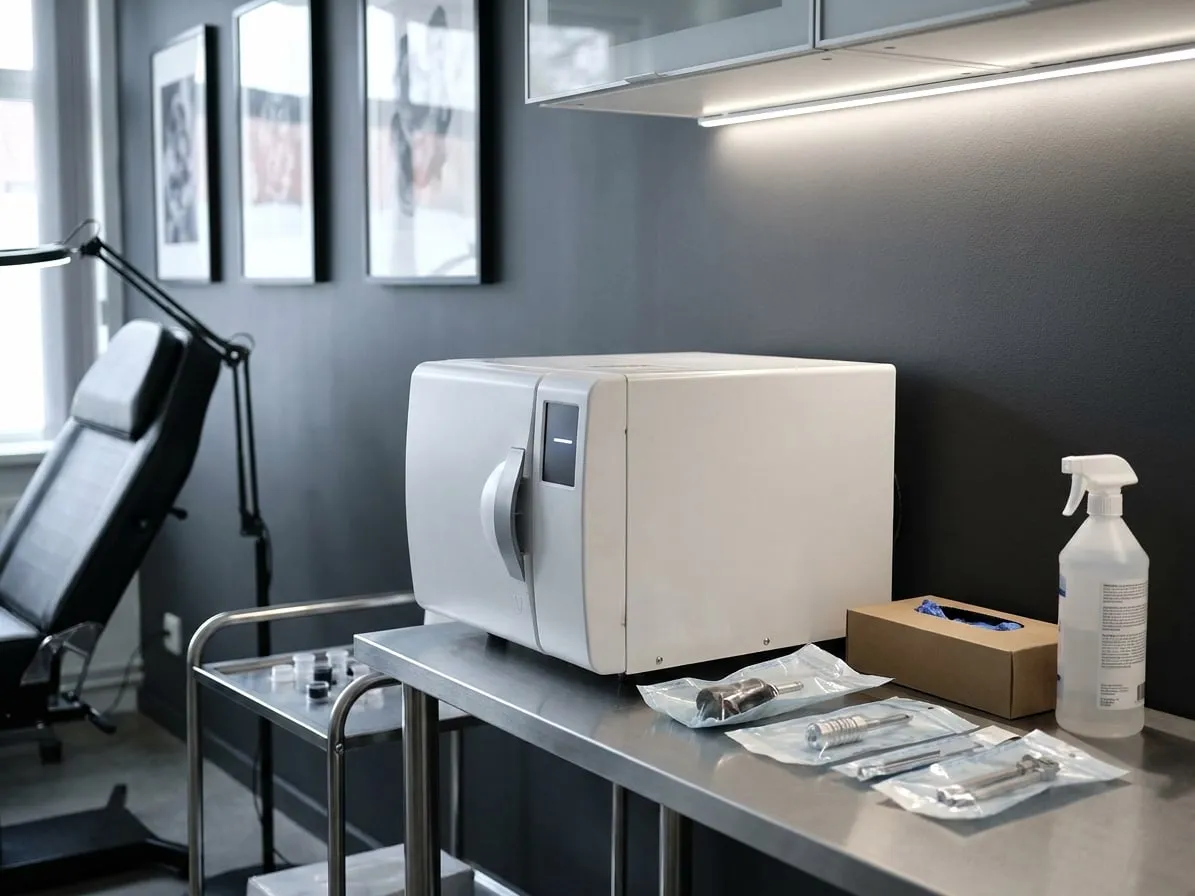
Who these rules apply to
The California Safe Body Art Act (Health and Safety Code §119300 and following, with the sterilization rules in §119315) covers body art practitioners and facilities, tattoo and piercing studios among them. The autoclave requirements apply to a studio that cleans and sterilizes reusable instruments on site. As the Ventura and San Diego County summaries point out, a studio that works only with single-use, pre-sterilized instruments does not fall under them. Enforcement and inspection are local, through your county environmental health department, so their handout is the version to keep at the counter.
The autoclave itself
The law asks for an autoclave manufactured for sterilizing medical instruments. In practice that means the same tabletop steam sterilizers dental and medical offices run. Studio units usually fall into two kinds:
- Cassette units such as the SciCan Statim 2000 and 5000 — short cycles, small capacity, popular with studios that turn tubes and grips around quickly.
- Small chamber units such as the Midmark M9 or a Tuttnauer 2340M — longer cycles with drying, more room for pouched loads.
Either is acceptable under the law; what the law cares about is how you monitor and record it.
Spore testing: three triggers
A spore test — a biological indicator run through a cycle and incubated — is required:
- After initial installation of the autoclave.
- After any major repair.
- At least monthly after that.
The results are kept for three years. This is stricter on records than the dental rule (weekly tests, 12 months of records) and, unlike the dental rule, the post-repair test is written into the law itself. For how spore tests work and how the other California rules compare, see spore testing in California.
Every load: mechanical readings and an integrator
Monthly spores are the floor, not the whole picture. Every load also needs:
- Mechanical indicators — the time, temperature and pressure the unit reached, from its display or printout.
- At least a Class V integrator in the load. Ordinary indicator tape or pouch markings only show that the package saw steam; an integrator responds to time, temperature and steam together.
The load log, kept three years
Each load gets a line in a log kept for three years, showing:
| Entry | What to write |
|---|---|
| Date | The day of the cycle |
| Contents | What was in the load |
| Exposure time and temperature | From the display or printout |
| Integrator result | Pass or fail |
| Positive spore tests | The re-cleaning done, and proof of the next negative test |
A printer or data logger on the autoclave makes this easier, but a handwritten log with the integrator strips attached does the same job.
When the autoclave goes in for repair
Because the law requires a spore test after any major repair, a repair is a compliance event for a studio, not just a maintenance one. What that looks like with us:
- Before: if you need to keep working, a tested loaner is swapped in on the same courier stop — $149–$199 for up to 21 days. Each loaner arrives with its own passed spore test and cycle printout. One honest note: a studio used to a Statim will find the cycles on a chamber loaner noticeably longer.
- On the bench: we replace what failed, run full test cycles and give you a work order listing the parts and the cycles, which goes in your records next to the spore results.
- After: our bench cycles are not your spore test. Run a spore test on your own unit when it comes back, before using it for clients, and log it. The CDC's guideline for healthcare settings goes further after a major repair — three consecutive empty-chamber cycles with a biological and a chemical indicator — which is a reasonable standard to follow if your county has not told you otherwise.
Pickup and bench diagnostic is $125, credited toward the repair, with a written quote before any work. More on how we work with studios on the tattoo and piercing studios page.
Common reasons a studio autoclave fails a spore test
A failed spore test is not always the machine. First check the obvious: the right indicator for your sterilizer type, the load not overfilled, pouches not stacked flat against each other, the cycle run to completion. When the machine is the cause, what we usually find is a worn door gasket or Statim cassette seal that stops the chamber from holding temperature, a valve that does not close, or scale and dirty water from tap-water use. The cleaning guide covers the routine that prevents most of those.
This page summarizes the Safe Body Art Act provisions and county handouts listed below. It is not legal advice; for how the rules apply to your studio, check with your county environmental health department.
Questions
Does a tattoo shop in California need an autoclave?
Only if it reprocesses instruments. The Safe Body Art Act sterilization and testing rules apply to a studio that sterilizes its own reusable instruments. A studio that uses only single-use, pre-sterilized instruments is outside those requirements, as the county handouts note. Your county environmental health department is the authority on how this applies to your studio.
How often does a tattoo studio have to spore test?
At least once a month, and also after the autoclave is first installed and after any major repair. The results have to be kept for three years.
What is a Class V integrator?
A chemical indicator that reacts to the combination of time, temperature and steam, not just to exposure. The Safe Body Art Act requires at least a Class V integrator in every load, alongside the mechanical readings of time, temperature and pressure.
Can we use any autoclave?
The law requires an autoclave manufactured for sterilizing medical instruments — the tabletop units dental and medical offices use, such as Midmark, Tuttnauer and SciCan models. Consumer or beauty sterilizers that are not made for medical instruments do not meet that.
Still not working?
Then the fault is inside the unit. We pick it up anywhere in Southern California, find the fault on the bench and quote it before any work — $125 for pickup, diagnostic and return, credited toward the repair. A loaner can ride along on the same stop.
Sources
- California Health and Safety Code §119315 (Safe Body Art Act)
- Ventura County Environmental Health — body art facility autoclave and sterilization requirements
- San Diego County Environmental Health — Safe Body Art Act summary
- CDC — Guideline for Disinfection and Sterilization (2008): sterilizing practices