SciCan Bravo autoclave repair: the Bravo G4 Class B vacuum unit
SciCan Bravo repair for the Bravo G4 and the older Bravo 17V and 21V — SciCan's chamber sterilizers with a vacuum pump. We pick the unit up anywhere in our Southern California area, find the fault on the bench, quote it before any work, and send it back with a passed vacuum test, a Bowie-Dick test and full cycle records.
Models we see: SciCan Bravo G4 (17 L and 22 L US models), older Bravo 17, 17V and 21V.
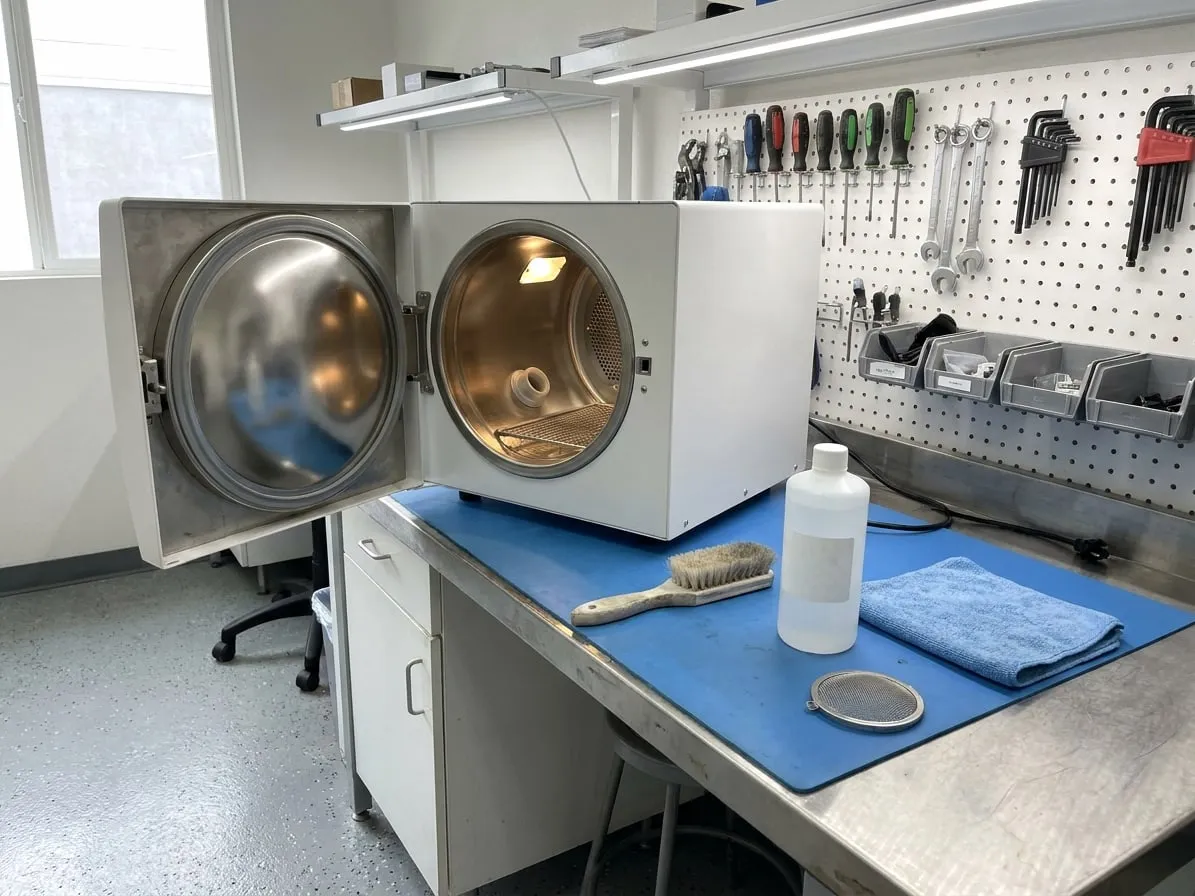
What the Bravo is — and why it is not a Statim
SciCan makes two very different sterilizers. The Statim is a cassette unit that injects steam into a small removable cassette. The Bravo is a chamber autoclave with a door, trays and a vacuum pump. Before and between the steam pulses, the pump pulls the air out of the chamber in several vacuum pulses, so steam reaches the inside of wrapped and hollow loads instead of being blocked by trapped air. That is the Class B / pre-vacuum principle, and it is why the Bravo has two tests a gravity autoclave does not:
- The vacuum test pulls a vacuum in the empty, cold chamber and watches how fast it is lost. It tests the seal of the whole system: door gasket, chamber, tubing and valves. SciCan suggests running it at the start of each working day.
- The Bowie-Dick test (B&D) is a 134 °C, 3.5-minute cycle with a test pack on the lowest tray near the door, nothing else in the chamber. It shows whether air removal works. The pack is not supplied with the unit. More in our Bowie-Dick guide.
Because air removal depends on everything holding vacuum, Bravo faults cluster in a few places: the door gasket letting air in, the vacuum pump wearing out, a leak somewhere in the hydraulic circuit, the water injection pump and steam generator, and clogged chamber and drain filters. Water quality runs through all of it.
What it does, what failed, what it costs
| Symptom | Usual cause | What we do | Price |
|---|---|---|---|
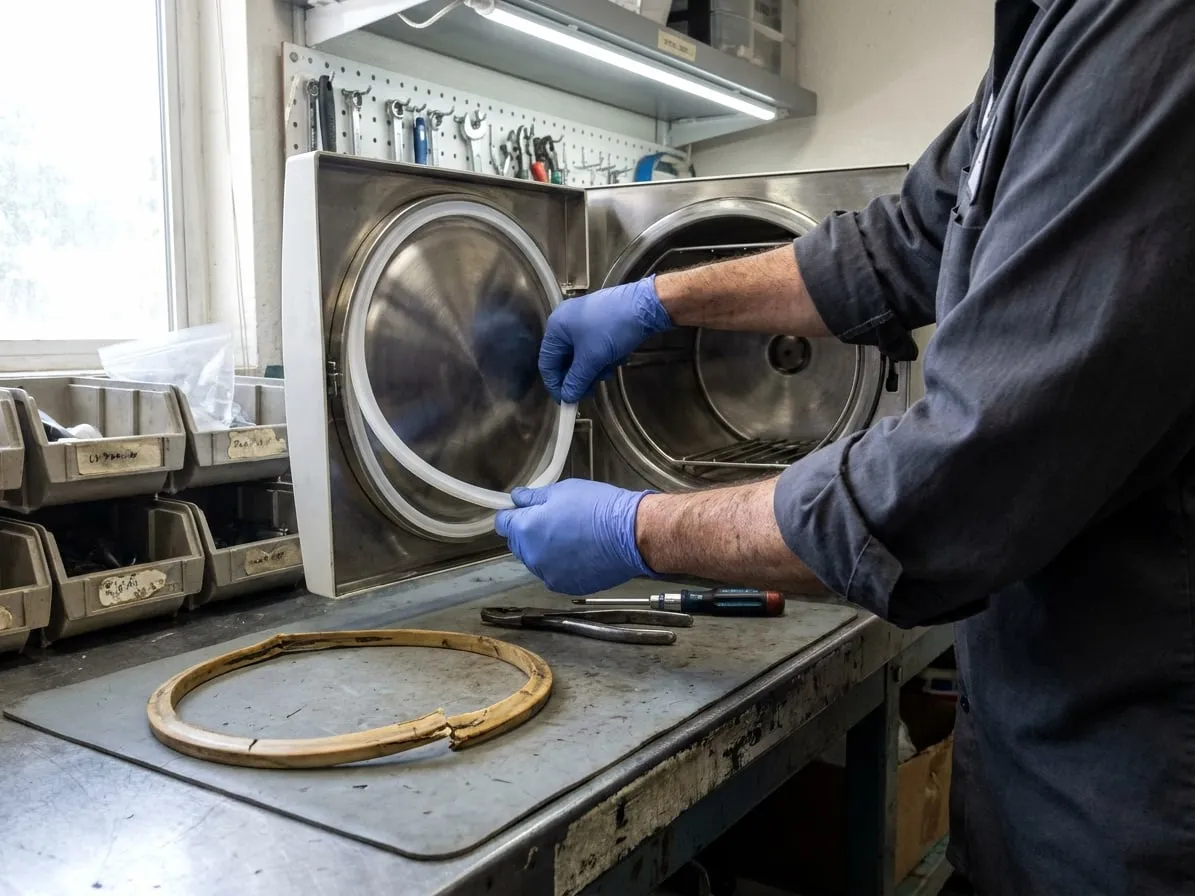
| Vacuum test fails, vacuum-pulse time-outs, steam at the door | Door gasket letting air in — worn, dirty or past its 1,000-cycle / 1-year interval | Gasket replaced, door adjusted, vacuum test and full cycle on the bench | from $249 |
| Vacuum test fails with a good gasket, cycles time out pulling vacuum | Vacuum pump worn or failed, a leak in the hydraulic circuit, a solenoid valve not sealing | Pump tested and rebuilt or replaced, circuit leak-tested, valves checked | from $499 |
| Pressure pulses or the return to atmosphere time out | Water injection pump, steam generator safety thermostat tripped, blocked chamber or drain filter, too much load or condensate | Filters cleaned, injection pump and thermostat tested, failed part replaced | from $499 |
| Door will not lock or unlock, door-lock alarms | Door lock not lubricated, limit microswitch or door gearmotor failed | Lock serviced and lubricated, microswitch or motor replaced | from $399 |
| Water quality alarms, unit locked after a few cycles | Feed water over 15 µS/cm, dirty tank, or a conductivity sensor fault | Tanks drained and cleaned, sensor checked; the water question answered | from $349 |
| Pre-heating time-out, overheating hazards, probe open or short | Steam generator or band heater element, PT1/PT2/PT3 temperature probe | Elements and probes measured, failed part replaced | from $449 |
| Board, driver, pressure sensor or memory faults | Process board, solenoid or door-motor driver, MPX pressure sensor | Board or sensor repaired or replaced, cycles verified | from $449 |
Prices are "from", with labor, ordinary parts and a test cycle. The final price comes after the bench diagnostic, and nothing is done until you approve it. All prices →
Bravo G4 alarm codes, by group
A Bravo alarm is a letter and three digits. SciCan sorts them into four groups by how serious they are and who is expected to fix them:
- E — errors and warnings. Usually a handling problem or a cause outside the unit, and usually something the office can fix: power cuts and mains problems, water conductivity too high, door open or not closed, the door lock, water tank levels (fill tank low, drain tank full), network and cloud firmware messages, failed vacuum tests, and a cycle stopped by hand. Holding STOP to end a cycle always gives E999, and that load is not sterile.
- A — alarms. First-level faults, normally for a technician: water level sensors and the automatic fill, the temperature probes (chamber, steam generator, heating band, conductivity compensation) reading open or short, the process board and its solenoid-valve and door-motor drivers, individual solenoid valves, pre-heating time-outs, and time-outs on the vacuum pulses, pressure pulses and returns to atmospheric pressure. Several of the vacuum time-outs tell you to check the load and the chamber filter first.
- H — hazards. Second-level faults in the sterilization phase: the pressure sensor open or shorted, temperature and pressure disagreeing, temperature or pressure outside its limits, timer errors, and overheating of the chamber, the steam generator or the heating band. These end the cycle as failed.
- S — system errors. Electronics and firmware: flash memory on the process board, the USB key, the printer.
What to check before you call
- Failed vacuum test or vacuum time-out: clean the door gasket and the door porthole with a clean cotton cloth moistened with water, check the gasket for damage, make sure the chamber is dry and not overloaded, clean the chamber filter, and run the test again with the chamber cold.
- Water warnings: drain the tank and refill with distilled or demineralized water under 15 µS/cm (pH 5–7). If you use an automatic fill, empty and refill the external container too.
- Door lock alarms: SciCan asks for door lock lubrication every 250 cycles or 3 months. Reset per the instructions on the screen; if it repeats, the microswitch or gearmotor is next.
- Power alarms: check the outlet, the main switch and the power cord, then reset. Repeated mains faults are an electrician's question before they are ours.
Always reset with the unit on — SciCan says not to switch it off before the reset. Unplug and let it cool before touching anything inside the chamber.
Bravo G4 maintenance, by SciCan's schedule
- Daily: clean the door gasket and the inside of the door.
- Monthly: clean the chamber, trays and the outside.
- Every 250 cycles or 3 months: clean the chamber filter; lubricate the door lock.
- Every 500 cycles or 6 months: clean the anti-dust filter; replace the bacteriological filter.
- Every 1,000 cycles or 1 year: replace the door gasket and validate the sterilizer.
- Every 3,000 cycles or 3 years: general service. Yearly: clean the internal water tank.
SciCan rates the Bravo for a 10-year life at about five cycles a day. Keeping it there is mostly the gasket, the filters and the water. Our bench preventive maintenance is $349, and every repair price is on the pricing page.
A loaner while the Bravo is away — read this first
We can swap in a tested loaner on the same courier stop, $199 for up to 21 days, free on repairs over $900. Be clear about what it is: an M11-class chamber autoclave that runs gravity-type cycles, not a Class B vacuum unit. It has no vacuum cycle and no Bowie-Dick test. For the loads your instrument makers allow on a gravity cycle it keeps you running; anything your protocol requires on a pre-vacuum cycle has to wait for the Bravo or go to another Class B unit.
Related
Bowie-Dick test
What it proves, which autoclaves need it and which do not.
Door gasket replacement
Leaking door, steam at the seal, cycles that abort.
SciCan Statim
Statim 2000 and 5000 cassette autoclaves, G4 included.
Tuttnauer T-Edge
T-Edge 10 and 11, including the Class B models.
Preventive maintenance
Gaskets, filters, cleaning and a test cycle before something fails.
Loaner autoclaves
A tested loaner swapped in on the same stop, so you never stop sterilizing.
What the price includes
- Pickup and return anywhere in our Southern California area, the bench diagnostic and a written quote — $125, credited toward the repair.
- After the repair: full cycles on the bench with a temperature and pressure check, the printout or log kept for your records.
- A loaner on the same stop if you need one — from $149, free on repairs over $900.
- 90-day warranty on repairs, 1 year on overhauls.
Questions
Is the SciCan Bravo a Class B autoclave?
Yes. The Bravo G4 is a pre-vacuum unit: a vacuum pump pulls air out of the chamber in fractionated pulses before and between steam pulses, it has a built-in vacuum test and a Bowie-Dick test cycle. That is what separates it from gravity units like the Midmark M11 or the Statim cassette units.
How often should the Bravo door gasket be replaced?
SciCan says every 1,000 cycles or 1 year, whichever comes first, and the unit reminds you. Clean the gasket and the inside of the door daily. A gasket that lets air in shows up first as a failed vacuum test.
Do we need to run a Bowie-Dick test on a Bravo?
Yes — a Bravo is a pre-vacuum sterilizer, and the Bowie-Dick test is the check that air removal works. Run it daily before the first load in an empty chamber. SciCan also suggests running the vacuum test at the start of each working day with the chamber cold. After a repair we run both on the bench and send the results.
Can you give us a loaner while the Bravo is in the shop?
Yes, but it is a chamber autoclave of the M11 class, not a Class B vacuum unit — $199 for up to 21 days, free on repairs over $900. It runs gravity-type cycles, so it has no vacuum or Bowie-Dick cycle. If your protocols or instrument instructions call for a pre-vacuum cycle for some loads, plan for those while the Bravo is away.
Why does our Bravo lock out after a water warning?
The Bravo measures the conductivity of its water at the start of every cycle. When the water is very poor, it allows a maximum of five more cycles and then locks until the tank holds water under 15 µS/cm. That protects the steam generator. Drain, refill with distilled or demineralized water and reset.
Book a pickup
Tell us the model, the error on the screen and what it does. A technician reads it and texts you back with a price range and the next pickup day in your area.
- Pickup, bench diagnostic and return — $125, credited toward the repair
- A tested loaner swapped in on the same stop, from $149 — free on repairs over $900
- A written quote before any work starts
- Typical bench time: 3 to 5 business days on the bench, parts permitting
Rather talk? Call or text (424) 622-8416.