How to clean an autoclave: schedules for Midmark, Tuttnauer, Statim and Bravo
Most of the autoclaves we open for fill faults, drying problems and rust were not broken so much as dirty. Knowing how to clean an autoclave properly — the right cleaner, at the right interval, for your model — prevents a good share of bench repairs. Below are the manufacturers' own schedules, summarized, with the steps people usually skip.
Why cleaning is a repair issue
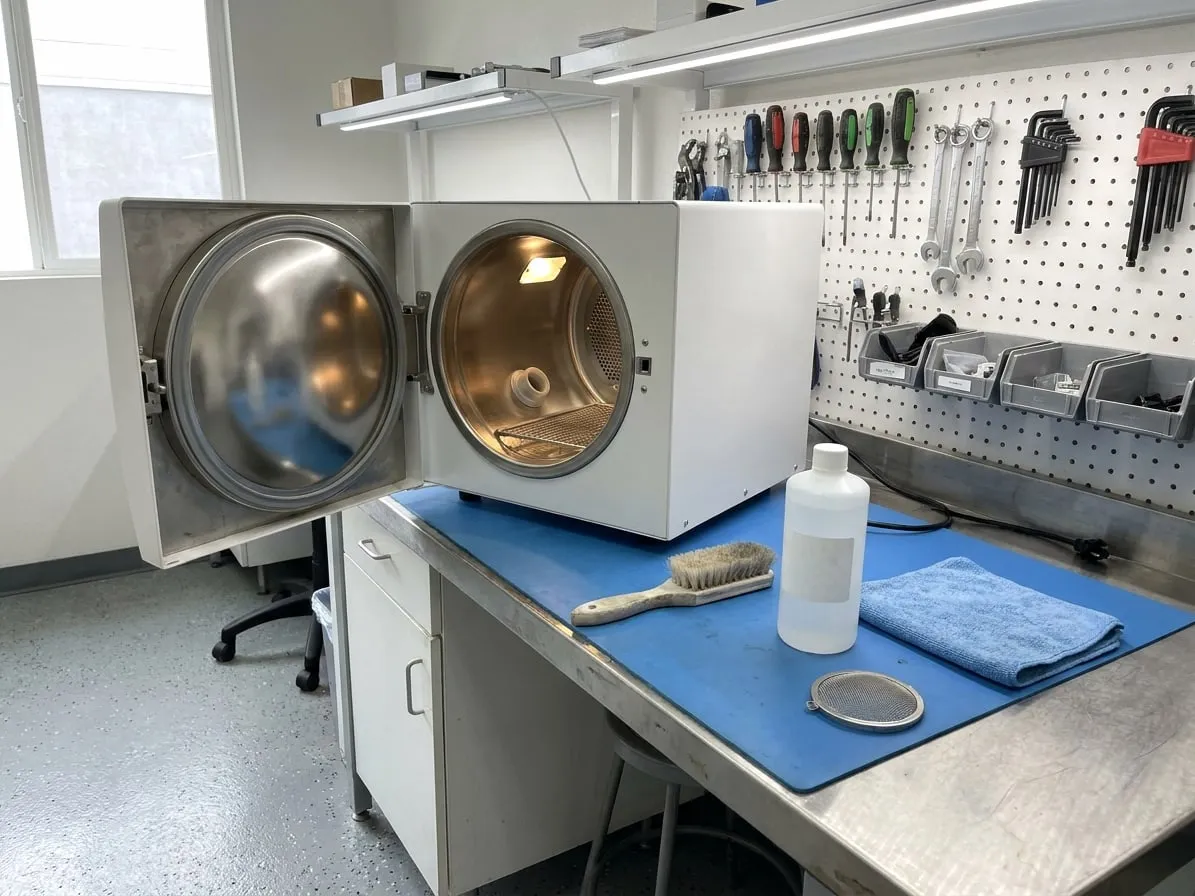
Every manufacturer says the same thing in different words. Midmark ties clogged chamber filter screens and dirty water-level sensors to its fill faults, and missed maintenance to rust and odor. Tuttnauer warns that if the chamber is not cleaned, debris builds up and clogs the tubing and valves, can transfer to the instruments, and that a layer of dirt holding moisture against stainless steel eventually makes the chamber porous. Cleaning is cheap; a chamber, a fill valve or a pump is not.
Midmark M9 and M11: Speed Clean
Midmark's routine-care sheet for the current M9 and M11 (-050/-051/-053) lays it out by interval:
- Daily: wipe the outside, inspect and clean the door gasket. Draining and refilling with distilled water is optional.
- Weekly — only if the monthly care is not being done: drain and refill, clean the trays, rack, plate and chamber with Speed-Clean, and rinse with distilled water.
- Monthly: run a cleaning cycle with 1 oz of Speed-Clean, then a rinse cycle with distilled water; clean the filters; wipe the chamber and trays; check the pressure relief valve.
For wiping surfaces, Midmark's dilution is 20 parts distilled water to 1 part Speed-Clean. Older red-display and C-code units follow the same pattern: a weekly drain and refill and a monthly Speed-Clean run.
One point where Midmark's own documents disagree: the current sheet says the pressure-relief-valve prompt appears every six months, while older guidance says check it monthly. Doing it monthly costs nothing; if in doubt, follow the sheet for your exact model.
Two habits that cause trouble on these units, both named by Midmark: adding a rust inhibitor ("instrument milk") to the reservoir, which causes odor, and wrapping in towels with chlorine residue from the laundry, which is one of the listed causes of rust. Midmark also lists the door and dam gasket kit as a yearly replacement — see door gasket replacement.
Tuttnauer EZPlus and E-series: Chamber Brite
The EZ9Plus and EZ11Plus manual has a dedicated Chamber Brite program. Its schedule:
- Daily: clean the door gasket and the chamber rim.
- Weekly or every 20 cycles: clean and descale the chamber, copper tubes and reservoir with Chamber Brite. At minimum, drain and refill the reservoir with distilled water weekly, clean the water-level sensor — its sides matter more than its tip — and oil the door pins. (One section of the manual phrases the interval as "whichever is longer"; the maintenance table says weekly or 20 cycles. Busy offices should treat it as whichever comes first.)
- Monthly: check the safety valve and clean the water-outlet strainer.
- Every 6 months or 1,000 cycles: replace the air (HEPA) filter.
- Every 12 months: inspect the door gasket and replace it if torn or leaking.
The Chamber Brite cycle itself, in short: start with a cold chamber (powder on a hot chamber burns and smells), take out the trays and holder, spread one packet in an even line along the chamber floor, run the cleaning program, drain the reservoir, refill with distilled water, run the program a second time with no powder to flush the plumbing, drain again and wipe the chamber. Tuttnauer is explicit that bleach, steel wool, steel brushes and abrasives must never touch the chamber, trays or holder, and that the cleaning program is not a sterilization cycle.
SciCan Statim: the cassette, STAT-DRI and filters
On a Statim the cassette is the chamber, and most of the cleaning is there. From SciCan's service manual:
- Every refill: empty the waste bottle and fill it with water to the MIN line. For ophthalmic use, drain the reservoir at the end of each day.
- Weekly: wash the inside of the cassette with dish soap or a mild detergent that contains no chlorine, scrub with a pad made for Teflon-coated surfaces, and rinse off every trace of detergent. Weekly matters most if you run lubricated handpieces.
- STAT-DRI Plus drying agent goes on after each cassette cleaning and every 10 cycles — except on the US G4 models G4-121101 and G4-201103, where SciCan says not to use it.
- Weekly checks: the air/biological filter (replace if dirty; call for service if it is wet) and the reservoir filter.
- Every 500 cycles or 6 months: replace the cassette seal and the air/biological filter.
SciCan also warns against cleaning the boiler with CLR. A Statim with a contaminated steam generator throws cycle faults that look like part failures; often the real cause is water — see what water to use.
SciCan Bravo G4
The Bravo's schedule runs on cycle counts as much as dates:
| Interval | Task |
|---|---|
| Daily | Clean the door gasket and the inside of the door — a soft water-and-vinegar solution removes limescale; dry it after |
| Monthly | Clean the chamber, trays and support with water and a little neutral detergent, rinse with distilled water; clean the outside |
| 250 cycles or 3 months | Clean the chamber filter; lubricate the door lock |
| 500 cycles or 6 months | Clean the anti-dust filter; replace the bacteriological filter |
| 1,000 cycles or 1 year | Replace the door gasket |
| Yearly | Clean the internal water tank |
SciCan warns against using sharp tools to scrape scale from the chamber. If you see deposits, check the water you are buying before anything else.
Habits that apply to every brand
- Distilled water only, in the reservoir and for every rinse. Most "dirty chamber" problems start in the jug.
- Clean, rinsed, dry instruments. Detergent and disinfectant residue on instruments ends up in the chamber.
- No improvised chemicals. Bleach, chlorine products and abrasives damage stainless chambers and seals.
- Write it down. A line in the sterilizer log for each cleaning cycle helps when a fault appears later — and it is the first question we ask.
If the schedule has slipped for months, a single cleaning cycle may not clear clogged filters, scaled sensors or a fill valve that has started to stick. That is what our bench preventive maintenance covers: gaskets and filters replaced, chamber and plumbing cleaned, sensors cleaned and a full test cycle — $349, with pickup across Southern California and a loaner if you need one.
Questions
How often should an autoclave be cleaned?
Wipe the door gasket daily on every brand. Beyond that it depends on the unit: Midmark asks for a monthly Speed-Clean cycle on the M9 and M11, Tuttnauer a Chamber Brite cycle once a week or every 20 cycles on the EZPlus, SciCan a weekly cassette wash on the Statim, and a monthly chamber clean plus filter work by cycle count on the Bravo.
Can I use vinegar or CLR to descale an autoclave?
Use what your manufacturer names. SciCan does suggest a mild water-and-vinegar solution for the Bravo door gasket and porthole. SciCan also warns against using CLR to clean a Statim boiler. For Midmark and Tuttnauer chambers, the manuals name Speed-Clean and Chamber Brite; other products can leave residue or attack seals.
Why does my autoclave smell bad?
Midmark lists two causes for odor on the M9 and M11: missed cleaning, and someone adding a rust inhibitor such as instrument milk to the reservoir. On Tuttnauer units, putting Chamber Brite into a hot chamber also gives off a strong smell. Drain, clean and refill with distilled water; if it persists, the unit needs a look.
Is Midmark Speed Clean safe to use on other brands?
Follow each manufacturer. Midmark specifies Speed-Clean for its units, Tuttnauer specifies Chamber Brite for its own, and SciCan specifies a chlorine-free detergent for the Statim cassette. Using another brand’s cleaner is not something the manuals cover.
Still not working?
Then the fault is inside the unit. We pick it up anywhere in Southern California, find the fault on the bench and quote it before any work — $125 for pickup, diagnostic and return, credited toward the repair. A loaner can ride along on the same stop.
Sources
- Midmark M9/M11 Routine Care sheet 003-10535-00
- Midmark Technical Library — M9/M11 troubleshooting (rust, odor, gasket kit)
- Midmark quick reference 004-0390-00 (older M9/M11)
- Tuttnauer EZ9Plus / EZ11Plus operator manual, Rev V (maintenance, Chamber Brite)
- SciCan Statim 5000 / 5000S / G4 service manual, routine maintenance
- SciCan Bravo G4 operator manual, maintenance