Veterinary autoclave repair
A veterinary autoclave works harder than most: wrapped surgical packs, drapes and gowns, full chambers and long dry times, often several cycles back to back on a surgery day. We repair the tabletop chamber units vet clinics rely on, on the bench, with courier pickup across Southern California and a loaner on the same stop.
Models we see: Midmark M11 and M9, Tuttnauer 2540M, 2340M, EZ10, EZ11Plus and the 3870 class, SciCan Bravo.
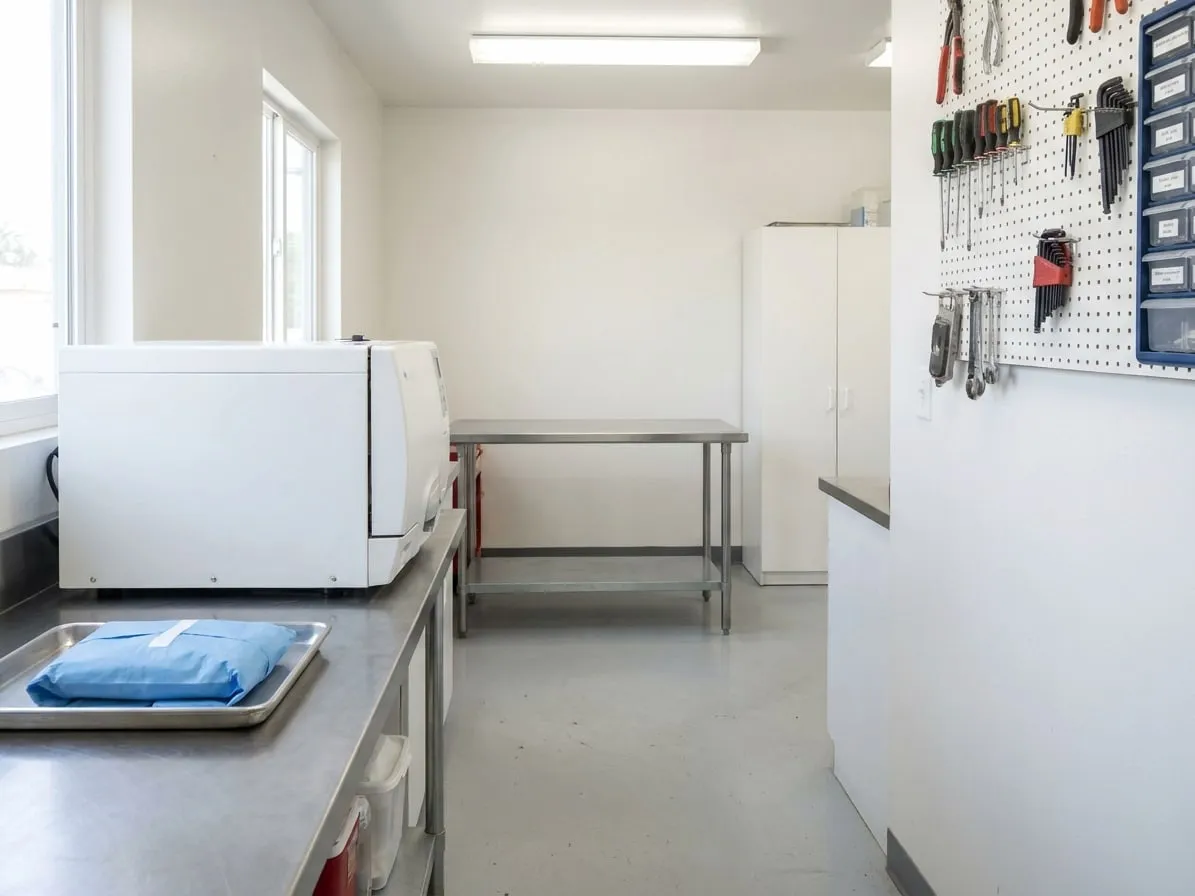
Big loads, wrapped packs, long cycles
A dental office runs small, unwrapped loads all day. A veterinary clinic's sterilizer more often runs fewer, heavier cycles: wrapped surgical packs, drapes and gowns, on the longest program with the full dry time. That changes how the unit wears and how it fails.
- Load weight matters. Midmark's wrapped cycle on the M11 is rated for 9 lb, and 8 lb on the M9; the EZ11Plus takes up to 15 lb of solid load. Overloading is on Midmark's and Tuttnauer's lists of causes for pressure and heat-time faults. A unit that faults only on surgery days may be telling you about the load.
- Wraps and towels hold water. Midmark names over-wrapping and chlorine residue from laundered towels among the causes of rust in the chamber. Wet packs come from overloading, tightly packed wraps or a drying problem — and a wet pack is not one you want to open in surgery.
- Long cycles stress the seals. The door gasket sits at temperature longer on every cycle. Midmark calls for a new gasket kit every year; on a heavy surgical schedule it is worth checking more often.
When the unit goes down before a surgery day, the loaner is the part that matters: it arrives when yours leaves, and your packs go into it that afternoon.
What it does, what failed, what it costs
| Symptom | Usual cause | What we do | Price |
|---|---|---|---|
| Wrapped surgical packs come out wet | Overloaded or over-wrapped chamber, clogged filters, drying fault, or a vent valve not clearing | Filters and vent path cleaned, drying cycle verified with a full load, loading advice | from $349 |
| Pressure fault with a full chamber (Midmark E005, Tuttnauer Heat Time Error) | Overload is on both makers' lists, as are a drifting temperature sensor and, on older Midmark units, the air-vent bellows | Sensor and bellows checked, cycle run with a real pack load and logged | from $399 |
| Rust spots on instruments or in the chamber | Missed cleaning, poor water, wet instruments, chlorine residue from laundered towels, over-wrapping | Chamber cleaned, water and wrap practice checked, valves inspected | from $349 |
| Chamber unit slow to heat or aborts on low temperature | Heating element, steam leak, unit not level, temperature or water-level sensor | Element and sensors measured, leak sealed, full cycle logged | from $449 |
| Water under the unit or the GFI trips | Heater gasket, dam or door gasket, manifold block, relief valve | Leak traced under pressure, gasket or valve replaced, electrical safety test | from $399 |
| Door seeps steam on long wrapped cycles | Door gasket past its yearly change | Gasket replaced, door adjusted, seal proved on a full cycle | from $249 |
| Tuttnauer LOW WATER mid-cycle on a large chamber | Dirty or shorted water electrode, clogged pump or line, a leak somewhere in the steam path | Electrode cleaned or replaced, fill path cleared, leak found | from $399 |
Prices are "from", with labor, ordinary parts and a test cycle. The final price comes after the bench diagnostic, and nothing is done until you approve it. All prices →
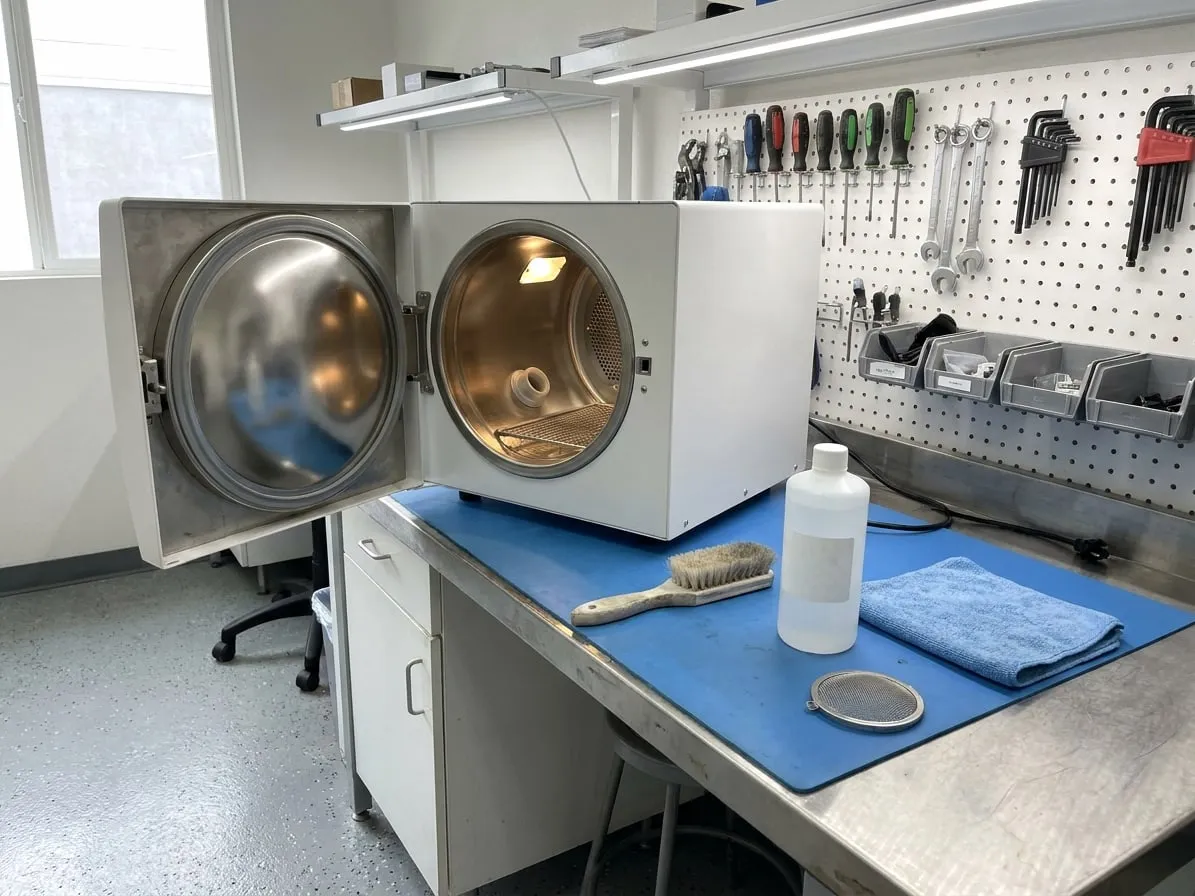
The chamber units vet clinics run
Midmark M11. An 11 × 18 inch chamber, wrapped cycles at 132 °C for 4 minutes or 135 °C for 3, with a default 30-minute dry. It is a gravity unit: no vacuum pump, air pushed out through an air valve. Its usual repairs are door and dam gaskets, fill and vent valves, the heater and its gasket, and temperature faults traced to a leak, an unlevel unit or a sensor. See Midmark M11 repair.
Tuttnauer 2540M and the 3870 class. Manual gravity units with roomy chambers — the 2540M is roughly 10 × 19 inches, and the 3870 is the large 15 × 28 inch class. They are simple machines; the parts that wear are the door gasket, the heating element and the safety valve. See Tuttnauer 2540M and Tuttnauer 3870.
Automatic Tuttnauer and Bravo. EZ10 and EZ11Plus clinics see LOW WATER and Heat Time Error when the water electrode gets dirty or the chamber is overloaded. A Bravo adds a vacuum pump and a daily Bowie-Dick test; its door gasket is a 1,000-cycle or yearly change.
After any repair that touches how the unit heats or seals, confirm it before routine use. We send the logged bench cycles with the unit; see testing after repair for what to run on your side.
Related
Midmark M11
The 11-inch UltraClave: gaskets, heaters, valves, boards.
Tuttnauer 2540M
The manual workhorse, and the 2340M beside it.
Tuttnauer 3870
The large-chamber tabletop unit.
Loaner autoclaves
A tested loaner swapped in on the same stop, so you never stop sterilizing.
Preventive maintenance
Gaskets, filters, cleaning and a test cycle before something fails.
Testing after repair
Test cycles, temperature check and the paperwork your log needs.
What the price includes
- Pickup and return anywhere in our Southern California area, the bench diagnostic and a written quote — $125, credited toward the repair.
- After the repair: full cycles on the bench with a temperature and pressure check, the printout or log kept for your records.
- A loaner on the same stop if you need one — from $149, free on repairs over $900.
- 90-day warranty on repairs, 1 year on overhauls.
Questions
Is there a California spore-test rule for veterinary clinics?
We have not found a California rule that sets a spore-test frequency specifically for veterinary practices. The sensible default is the manufacturer's instructions and the CDC sterilization guideline: monitor every load, use indicators, test with a biological indicator regularly, and after a major repair run a biological and chemical indicator in three consecutive empty-chamber cycles before routine use. Check with your own board or accreditation body for anything stricter.
Why do our wrapped packs come out wet?
Usually the load, not the unit: too many packs, packs packed too tightly, or wraps that hold water. Midmark sets maximum loads for wrapped cycles (9 lb in an M11, 8 lb in an M9) and lists over-wrapping and chlorine residue from laundered towels as causes of rust. If a correct load still comes out wet, the filters, drain or vent side need attention.
Can you handle our large chamber unit?
We take tabletop units, including the large chamber ones — the Midmark M11, Tuttnauer 2540M and the 3870 class. Floor-standing and hospital sterilizers are a different job and we do not take them.
What about surgery days?
Book the pickup around them, and take the loaner. A tested unit comes on the same stop — $199 for an M11-class unit for up to 21 days, free on repairs over $900.
Sources
- Midmark Routine Care 003-10535-00 — M9/M11 cycles and maximum loads
- Midmark M9/M11 non-coded troubleshooting: rust, odor, water under unit
- Tuttnauer EZ9Plus / EZ11Plus operator manual, Rev V
- Tuttnauer E-series and EZ display messages (Allclave Parts)
- CDC — sterilizing practices (testing after major repair)
Book a pickup
Tell us the model, the error on the screen and what it does. A technician reads it and texts you back with a price range and the next pickup day in your area.
- Pickup, bench diagnostic and return — $125, credited toward the repair
- A tested loaner swapped in on the same stop, from $149 — free on repairs over $900
- A written quote before any work starts
- Typical bench time: 3 to 5 business days on the bench, parts permitting
Rather talk? Call or text (424) 622-8416.