Autoclave spore testing in California: how often, what to log, what to do after a repair
Spore testing is the only check that proves your autoclave actually kills microorganisms. In California a dental office runs a spore test at least weekly and keeps the results for a year; a tattoo studio tests at least monthly and keeps them for three. Here is what the rules say, what the CDC adds, and what to do after a repair or a failed test.
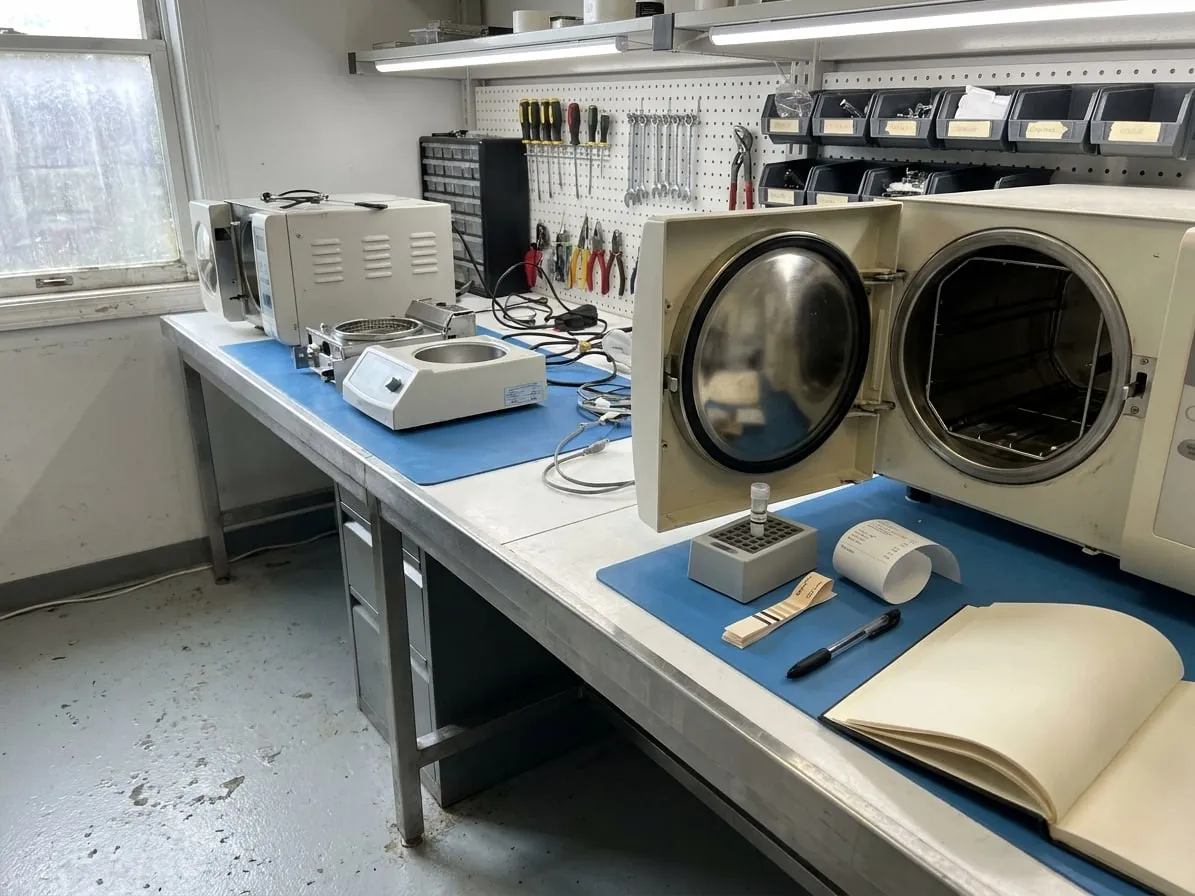
What a spore test proves, and what it does not
A spore test uses a biological indicator: a strip or vial loaded with bacterial spores that are harder to kill than anything on your instruments. It runs through a normal cycle with the load, then goes into an incubator next to an unprocessed control from the same lot. If the processed indicator shows no growth and the control does, the cycle killed the spores.
That is different from the other two kinds of monitoring a practice uses:
- Mechanical monitoring — the time, temperature and pressure the unit reports or prints. The CDC asks for these to be checked on every load.
- Chemical indicators — tape, pouch markings and internal strips that change color when exposed to steam. They show the package saw a process, not that it was sterile. The CDC asks for one inside every package, plus an outside one if the inside one cannot be seen.
- Biological indicators — the spore test. The only direct proof of kill, and the one the regulations count.
Use indicators made for your type of sterilizer. Midmark, for example, tells M9 and M11 owners to use biological indicator strips meant for gravity-displacement steam sterilizers, because those units remove air without a vacuum pump.
California dental offices: 16 CCR §1005
The Dental Board's infection-control rule is short on this point. Section 1005(b)(17) requires that sterilization cycles be verified at least weekly with a biological indicator, that the results be documented, and that the records be kept for 12 months. Steam under pressure, chemical vapor and dry heat are the accepted methods for critical and semi-critical items.
The regulation does not say what to do after a failed test, does not mention chemical indicators and does not mention repairs. For those, dental offices follow the CDC, which the next section covers. A detail people ask about: one continuing-education source says a backup or rarely used sterilizer still needs its weekly test. We have not found that in the text of §1005 itself, so read it as a sensible practice rather than a quoted rule, and ask the Dental Board if your setup depends on it.
What the CDC adds
The CDC's dental sterilization-monitoring guidance builds on the weekly test:
- Mechanical readings recorded for every load.
- A chemical indicator inside every package.
- A biological indicator at least weekly, with a control from the same lot.
- A biological indicator with every load that contains an implant, and the implants held until the result is negative.
- Records kept as state rules require — 12 months for California dental.
After a major repair: three empty cycles
This is the part most practices miss. The CDC's 2008 sterilization guideline says that after a sterilizer is installed, relocated, redesigned or has a major repair, it should run a biological and a chemical indicator in three consecutive empty-chamber cycles before routine use. On a pre-vacuum (Class B) unit such as a SciCan Bravo or a Tuttnauer T-Edge B, add three consecutive Bowie-Dick tests. Gravity units like the Midmark M9 and M11 do not take a Bowie-Dick test.
What counts as "major" is not defined line by line. A heater, a valve, a control board or anything that changes how the chamber seals, heats or removes air is a reasonable line to draw. When we return a unit, the paperwork lists what was replaced and the cycles we ran on the bench — that is what you need to decide, and to show an inspector later. Our bench cycles are not a substitute for your own spore tests on your own unit; we say so on every work order. See testing after repair for what the bench record includes.
Tattoo and body art studios: at least monthly, three years of records
The California Safe Body Art Act (Health and Safety Code §119315) is stricter on records than the dental rule. A studio that sterilizes its own instruments spore tests after installation, after any major repair and at least monthly, uses at least a Class V integrator in every load, and keeps the spore results and a load log for three years. Unlike §1005, the post-repair test here is written into the law. Details and county sources are in our tattoo studio autoclave guide.
Nail salons: no spore-test rule found
The Board of Barbering and Cosmetology rule for sterilized tools, 16 CCR §982, asks for a chemical indicator on each package and a weekly check that the unit reaches the manufacturer's temperature. We found no spore-test frequency in it. More on that, and on the study guides that claim otherwise, in the nail salon sterilization guide.
Rules at a glance
| Practice | Spore test | Records | After a major repair |
|---|---|---|---|
| Dental (16 CCR §1005) | At least weekly; with every implant load per CDC | 12 months | CDC: 3 empty cycles with BI + CI; 3 Bowie-Dick on vacuum units |
| Body art (H&S §119315) | After installation, after major repair, at least monthly | 3 years, plus a load log | Spore test required by law |
| Nail salon (16 CCR §982) | No frequency found; weekly temperature check | Not specified in §982 | Not addressed |
When a spore test fails
A single positive result is not yet proof the autoclave is broken — a mishandled strip, the wrong indicator type or an overloaded chamber can cause it. The CDC sequence is:
- Take the sterilizer out of service and re-test it right away, checking that the load, packaging and indicator were correct.
- If the repeat test is negative and the mechanical and chemical readings were fine, the unit can go back into use.
- If it is positive again, the sterilizer gets inspected or repaired. Before routine use it needs three consecutive negative biological indicators in fully loaded cycles.
- Recall implants processed since the last negative test, and re-process the other items from that period as far as possible.
On the bench, a repeat failure usually traces to something the unit is not telling you: a door gasket that leaks just enough to stall temperature, an air valve or bellows that closes early and traps air, a temperature sensor that reads high, or scale and dirty water that keep the chamber from reaching its numbers. A unit that passes its own display but fails spores is exactly the one that needs a full diagnostic rather than a new strip.
What to keep in the log
Whatever your rule, a useful sterilizer record has: the date, the cycle and its printout or readings, the indicator lot, the result and who read it, and — for failures — what was done and the date of the next negative test. Keep repair paperwork in the same binder: a dated note that the heater was replaced, followed by three negative tests, answers most inspection questions before they are asked. This page sums up the rules as written; for how they apply to your practice, check with the Dental Board or your county environmental health department.
Questions
How often does a California dental office have to spore test?
At least once a week, with a biological indicator, under 16 CCR §1005(b)(17). The results have to be documented and kept for 12 months. The CDC also recommends a biological indicator with every load that contains an implant.
Is a chemical indicator or tape enough?
No. Chemical indicators and tape show that a package was exposed to a process. Only a biological indicator — the spore test — shows the spores were killed. The CDC asks for a chemical indicator inside every package and a biological indicator at least weekly; one does not replace the other.
Do we have to spore test after the autoclave is repaired?
For tattoo and body art studios, yes — the Safe Body Art Act requires a spore test after any major repair. For dental offices §1005 does not mention repairs, but the CDC recommends three consecutive empty-chamber cycles with a biological and a chemical indicator after a major repair, plus three Bowie-Dick tests on vacuum units, before the sterilizer goes back into routine use.
What do we do if the spore test comes back positive?
Take the unit out of service and re-test it right away. If the repeat test is also positive, have the sterilizer inspected or repaired, then confirm three consecutive negative tests in fully loaded cycles before it goes back into use. Recall implants processed since the last negative test and re-process the other items from that period.
Still not working?
Then the fault is inside the unit. We pick it up anywhere in Southern California, find the fault on the bench and quote it before any work — $125 for pickup, diagnostic and return, credited toward the repair. A loaner can ride along on the same stop.
Sources
- 16 CCR §1005, Minimum Standards for Infection Control (Dental Board of California)
- CDC — Dental infection control FAQs: sterilization monitoring
- CDC — Guideline for Disinfection and Sterilization (2008): sterilizing practices
- CDC — Table 12, recommendations for a positive biological indicator
- California Health and Safety Code §119315 (Safe Body Art Act)
- Ventura County Environmental Health — body art facility autoclave requirements
- 16 CCR §977–982, Board of Barbering and Cosmetology health and safety rules