Tuttnauer T-Edge 10 and 11 repair
The Tuttnauer T-Edge 10 and T-Edge 11 are Tuttnauer's touchscreen automatics with a vacuum system, a pipe steam heater and separate clean and waste water tanks. Run in Class B mode they are true vacuum sterilizers — and they come with a daily Bowie-Dick test and a longer list of things that can fail.
Models we see: Tuttnauer T-Edge 10, T-Edge 11, T-Edge 10B and 11B, Class S and Class B.
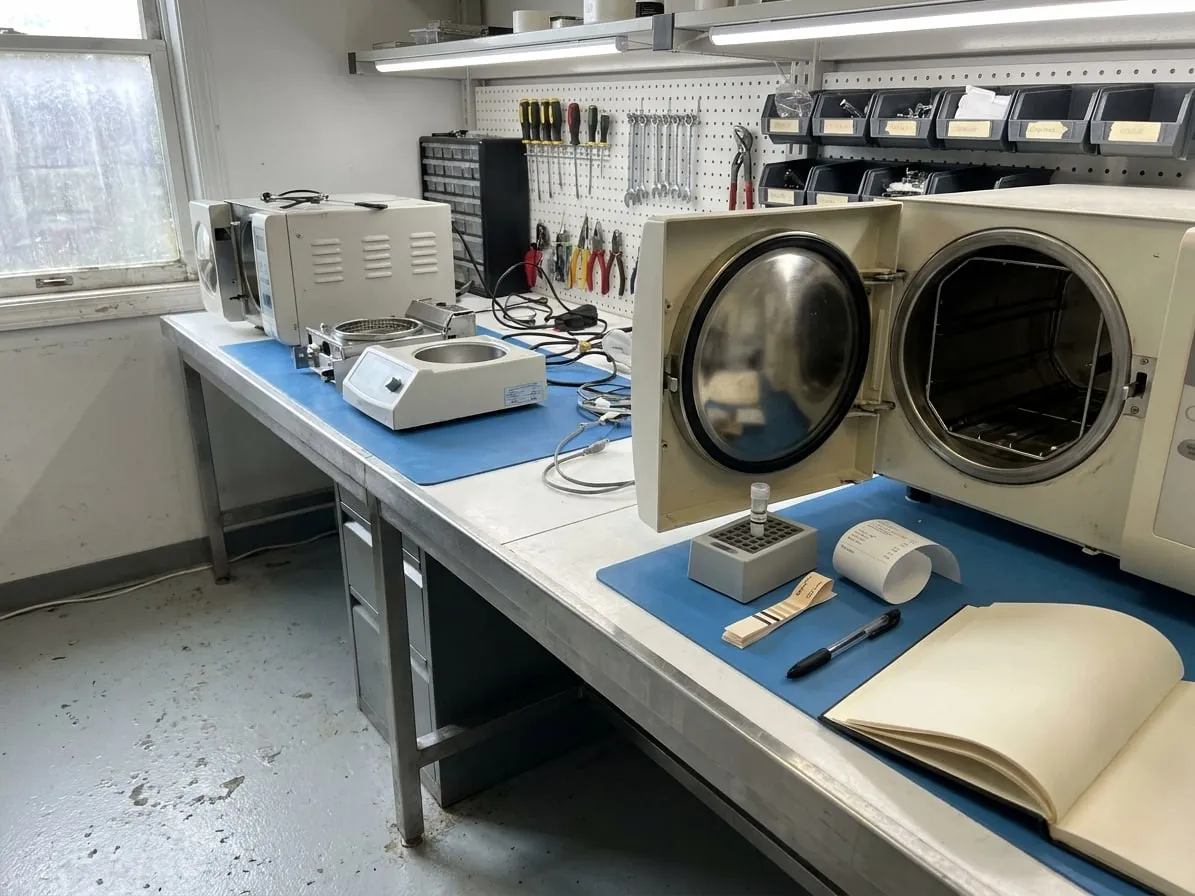
Class S and Class B on the same machine
The T-Edge 10 has a 10 × 18 inch chamber (23 L) and the T-Edge 11 an 11 × 18 inch chamber (about 27 L). According to the T-Edge 11 manual, every unit has a vacuum system that removes air from the load at the start of the cycle and pulls a vacuum to dry it at the end. What differs is depth. Class S — the US standard setting — pulls a weaker vacuum and runs 270 °F programs for unwrapped, wrapped, delicate and handpiece loads. Class B pulls a deeper vacuum for hollow, porous and multi-layer wrapped loads, runs 273 °F pre/post-vacuum programs, and adds a Bowie-Dick program and a vacuum test.
That makes the class a practical question, not a label. A T-Edge running Class B should pass a Bowie-Dick test every day, before the first load, in an empty chamber. The vacuum test is the other check: the chamber is pulled down, the valves close, and the unit watches for pressure creeping back over ten minutes. A failed vacuum test almost always means air is getting in — gasket, valve, fitting — or the pump is weakening. Run it on a dry, cool chamber, as the manual asks.
What it does, what failed, what it costs
| Symptom | Usual cause | What we do | Price |
|---|---|---|---|
| Vacuum time error, failed vacuum test or failed Bowie-Dick | Air leaking into the chamber at the gasket, a valve or a fitting, or a vacuum pump that no longer reaches its target in time | Leak traced under vacuum, gasket, valve or pump repaired, vacuum and Bowie-Dick tests rerun | from $399 |
| Pipe water heater or jacket water heater temperature time error | The steam (pipe) heater or the chamber heaters ran 15 minutes without reaching temperature: failed heater, its relay or wiring, or scale | Heaters, relay and wiring measured, heater replaced, steam path descaled | from $449 |
| Low Quality Water, Not enough water detected, Water fill Error | Water above the conductivity limit, a stuck float switch, or a fill pump that runs without moving water | Water path flushed, float and pump tested, quality sensor checked | from $499 |
| Low Temp, Low Pressure or steam at the door | Worn or dirty door gasket, door not closing fully, overloaded chamber | Gasket replaced, door adjusted, test cycle | from $249 |
| Utility issue messages, I/O card not connected, Analog Input Error | Control computer, I/O card or a sensor disconnected or out of range | Boards and sensors diagnosed, repaired or replaced | from $449 |
Prices are "from", with labor, ordinary parts and a test cycle. The final price comes after the bench diagnostic, and nothing is done until you approve it. All prices →
Maintenance from the manual
- Daily: clean the door gasket and check that it is intact and seated.
- Weekly: run the Chamber Clean program; drain the waste-water tank (sooner if the full-tank alarm shows).
- Monthly: descale the chamber and clean the drain filter at the back of the chamber floor.
- Every 3 months: check the door gasket for damage.
- Every 6 months or 1,000 cycles: replace the air filter.
The manual asks for deionized or distilled water at 15 µS/cm or less and warns that higher conductivity may cause failures; the unit has a water-quality sensor and will say "Low Quality Water". It runs on 120 V, 15 A. Message-by-message help is on Tuttnauer error messages; flat rates are on the price list. For comparison, dealers price a new T-Edge 10B at roughly $6,753–8,976 — a vacuum pump or heater repair is a fraction of that.
Related
Tuttnauer
2340M and 2540M, EZ9 and EZ10, 3870, Elara 11, T-Edge.
Bowie-Dick test
What it proves, which autoclaves need it and which do not.
Tuttnauer error messages
LOW WATER, LOW HEAT, HI TEMP and the rest, explained.
Tuttnauer Elara 11
The pre-vacuum Elara 11.
Testing after repair
Test cycles, temperature check and the paperwork your log needs.
Loaner autoclaves
A tested loaner swapped in on the same stop, so you never stop sterilizing.
What the price includes
- Pickup and return anywhere in our Southern California area, the bench diagnostic and a written quote — $125, credited toward the repair.
- After the repair: full cycles on the bench with a temperature and pressure check, the printout or log kept for your records.
- A loaner on the same stop if you need one — from $149, free on repairs over $900.
- 90-day warranty on repairs, 1 year on overhauls.
Questions
Is my T-Edge Class B?
Look at the screen header: the T-Edge 11 manual says a unit converted to Class B shows the Class B sign there, and its program list includes Bowie and Dick and Vacuum Test. Every T-Edge has a vacuum system; in the US the unit ships in Class S, which pulls a weaker vacuum, and Class B is unlocked with a code Tuttnauer issues against the serial number. Dealers sell "B" versions such as the T-Edge 10B and 11B.
How often should a Class B T-Edge run a Bowie-Dick test?
Daily, before the first load, in an empty chamber. The Bowie-Dick test checks air removal and steam penetration on pre-vacuum units — it is not a sterility test, so spore testing still applies. After a major repair, the CDC asks for three consecutive Bowie-Dick tests on a pre-vacuum unit, along with biological indicators in three empty cycles, before routine use.
Is there a loaner for a T-Edge?
Yes, the $199 M11-class loaner covers T-Edge workloads for up to 21 days (free on repairs over $900). It is not a Class B unit, so vacuum cycles for hollow and porous loads are not available until your T-Edge comes back.
Book a pickup
Tell us the model, the error on the screen and what it does. A technician reads it and texts you back with a price range and the next pickup day in your area.
- Pickup, bench diagnostic and return — $125, credited toward the repair
- A tested loaner swapped in on the same stop, from $149 — free on repairs over $900
- A written quote before any work starts
- Typical bench time: 3 to 5 business days on the bench, parts permitting
Rather talk? Call or text (424) 622-8416.