Nail salon sterilization in California: what the rules require, and what they do not
If you run a nail salon autoclave in California, the rule that covers it is short: the Board of Barbering and Cosmetology's §982 asks for an FDA-registered sterilizer used per its manual, a chemical indicator on every package and a weekly check that the unit reaches its temperature. Much of what circulates online — weekly spore tests, year-long spore logs — has no regulation behind it that we could find.
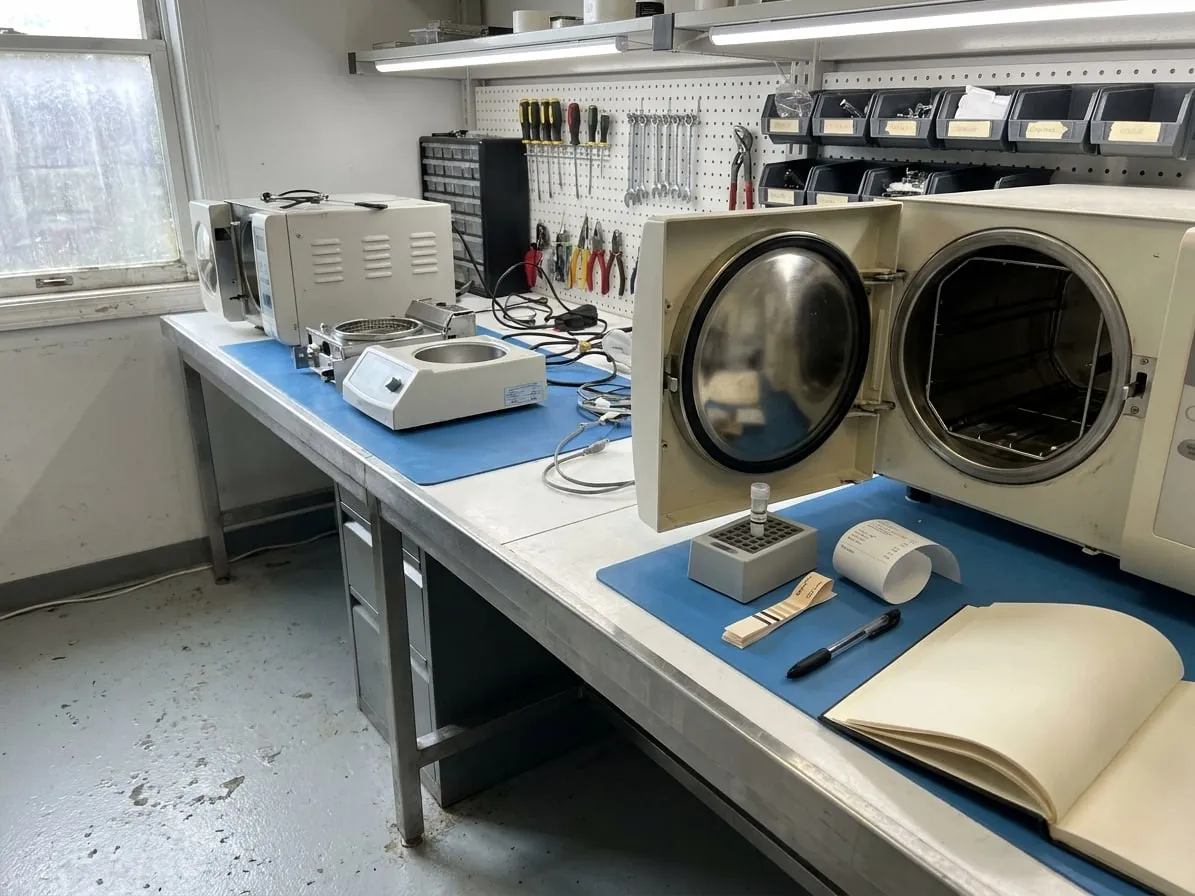
The rule that covers sterilizers: 16 CCR §982
The Board of Barbering and Cosmetology's health and safety rules are in Title 16 of the California Code of Regulations, sections 977 to 982. Section 982 is the one that talks about sterilizers, and it is written for electrolysis tools. Its requirements, in our words:
- Sterilize in an autoclave or a dry-heat sterilizer that is registered or listed with the FDA.
- Use it according to the manufacturer's instructions.
- Put a chemical indicator on each package.
- Check the sterilizer weekly to confirm it reaches the temperature the manufacturer specifies.
One link to the rest of the salon rules: §979(h) says non-electrical tools that are sterilized the way §982 describes are treated as meeting the disinfection requirement. So a salon that chooses to sterilize its metal implements in an autoclave, rather than disinfect them, is covered by following §982.
What we did not find: a spore-test requirement
Section 982 sets no spore-test frequency, and we found none elsewhere in §977–982. We have seen study guides and training material state that salons must spore test weekly and keep a year of logs. None of them cites a section, and the wording matches the dental rule — weekly biological indicators, records kept 12 months, from the Dental Board's 16 CCR §1005 — closely, which suggests it was carried over from dentistry.
We want to be careful in both directions here. We are not saying spore testing is pointless, and we are not saying a county inspector or a future rule change could never ask for more. We are saying the regulation text we reviewed does not require it. If your salon's practice depends on the answer, ask the Board of Barbering and Cosmetology directly and keep their reply.
How the three California rules compare
| Setting | Spore test | Records |
|---|---|---|
| Nail salon / electrolysis (16 CCR §982) | No frequency set; weekly temperature check, chemical indicator on each package | Not specified in §982 |
| Dental office (16 CCR §1005) | At least weekly | 12 months |
| Tattoo and body art (H&S §119315) | After installation, after major repair, at least monthly | 3 years |
Details for the other two are in spore testing in California and the tattoo studio autoclave guide.
Doing the weekly temperature check well
The rule does not say how to record the check, so make it easy to show:
- Once a week, run a normal cycle and note the temperature the unit reached, from its display or printout.
- Compare it with the temperature in the manual for that cycle — for example 132 °C or 135 °C on a Midmark M9's wrapped cycles.
- Write the date, the reading, the cycle and your initials in a log kept with the sterilizer.
- If it does not reach temperature, stop using it for tools until it is checked.
A unit that runs but never quite reaches temperature is a common bench fault, and the usual causes are a worn door gasket letting steam out, a heater losing output, scale from tap water on the sensors. Using distilled water only, as every manufacturer specifies, prevents much of it — see what water to use.
If you want more assurance than the rule asks for
Two optional habits are worth considering, as choices rather than obligations:
- A periodic spore test. It is the only direct check that the cycle kills microorganisms, and it costs little. If you do it, log the result.
- A spore test after a repair. The CDC recommends this for healthcare sterilizers after a major repair, and the body art law requires it. Nothing in §982 does, but it is a simple way to know the repaired unit works.
Service and repair
Salon autoclaves are usually small units — a Midmark M9, a Tuttnauer 2340M or a Statim — and they fail the same way as in any other practice. We pick them up across Southern California for a $125 bench diagnostic, credited toward the repair, and quote before any work. A tested loaner from $149 can come on the same stop. Full prices are on the pricing page.
This page summarizes the regulation text listed below as we read it. It is not legal advice; for how it applies to your salon, check with the Board of Barbering and Cosmetology.
Questions
Does a nail salon in California need an autoclave?
The Board of Barbering and Cosmetology rules we reviewed do not require one for ordinary nail tools, which can be disinfected under the Board’s disinfection rules. Section 982 sets the sterilization requirements for electrolysis tools, and §979(h) says non-electrical tools sterilized the §982 way count as meeting the disinfection rule. Check the current rules with the Board for your situation.
Do nail salons need weekly spore tests in California?
We found no such requirement. Section 982 asks for a chemical indicator on each package and a weekly check that the sterilizer reaches the manufacturer’s temperature. It sets no spore-test frequency. Study guides that say “weekly spore tests and 12 months of logs” do not cite a section, and we could not find one.
What does the weekly temperature check involve?
The rule says the sterilizer has to be checked weekly to make sure it reaches the temperature its manufacturer specifies. A unit with a display or printout shows it each cycle; record it in a simple log so you can show it was done.
Is it a bad idea to spore test anyway?
No. A spore test is the only direct proof that the sterilizer kills microorganisms, and it is inexpensive. Doing it voluntarily is a sound choice — just do not describe it to clients or staff as a legal requirement.
Still not working?
Then the fault is inside the unit. We pick it up anywhere in Southern California, find the fault on the bench and quote it before any work — $125 for pickup, diagnostic and return, credited toward the repair. A loaner can ride along on the same stop.